In many ways, it is a surprise that shipping’s “bigger is better” philosophy did not start to feel the strain sooner. But the pandemic certainly brought forward the schedule, with the few vessels then-deployed on the spot market suddenly raking in cartoonish earnings. In one example, X-Press Mekong, a 2.743 TEU Singaporean feeder built in 2020, fixed a charter of 55 days at S175.000 per day
If one was Lucky enough to get in early, a second hand ship purchase would be earning profit within weeks. But what was impossible to ignore about this handful of vessels was just how old they were. According to Alphaliner data, the average container vessel in the up-to-999 TEU size range is over the hill at 17.4 years old. Unlike X-Press Mekong, most small vessels are not even designed to be feeders, particularly: rather, they are the flagships of yesteryear, from a time when 4,000TEU was still ‘big’. In an article, the UN council on trade and development (UNCTAD) warned that Europe is facing “a chronic shortage of vessels in short sea shipping.”
If one was Lucky enough to get in early, a second hand ship purchase would be earning profit within weeks. But what was impossible to ignore about this handful of vessels was just how old they were. According to Alphaliner data, the average container vessel in the up-to-999 TEU size range is over the hill at 17.4 years old. Unlike X-Press Mekong, most small vessels are not even designed to be feeders, particularly: rather, they are the flagships of yesteryear, from a time when 4,000TEU was still ‘big’. In an article, the UN council on trade and development (UNCTAD) warned that Europe is facing “a chronic shortage of vessels in short sea shipping.”
“Can we then expect new capacity to come on-line over the next two to three years? Not so soon. Shipping supply can only be increased with a lag: it takes about two years to build a vessel,” the report read
The maritime industry is already starved for small vessels, then. But other post-pandemic trends are likely to compound the situation. Many manufacturers and retailers are seeking to spread their supply chains across several countries in order to prevent the risk of another covid-like situation bringing their sales to a halt. This will mean that shipping will have to change, as well – from a situation where China’s one stop-shop enables economies of scale, and produces many of the arguments for 20,000 TEU giants, to a fragmented one where many countries feed into the whole.
The smaller the required vessels become, the worse the economics of the traditional prime-mover and propeller combo become, and the more attractive battery-electric propulsion begins to look. Feeders are bad performers under the IMO’s new CII measure, as they spend a lot of time in port, and sail at higher average speeds. The case is being made by several new small vessel designs including Yara Birkeland, Japan’s Project e5. and an as-yet unnamed DB Schenker feeder ship.
Converging with this is an explosion in another sector, offshore wind, now finally reaching US shores. As well as wind-turbine installation vessels (WTIVs) a generation of new service and operation vessels (SOVs) will be needed to support this segment, not only at the building stage, but also over the course of maintaining the turbines. With their extraordinary requirement for manoeuvrability coupled with the growing possibility of being charged by turbine power at sea, these vessels will create additional demand for electric propulsion.
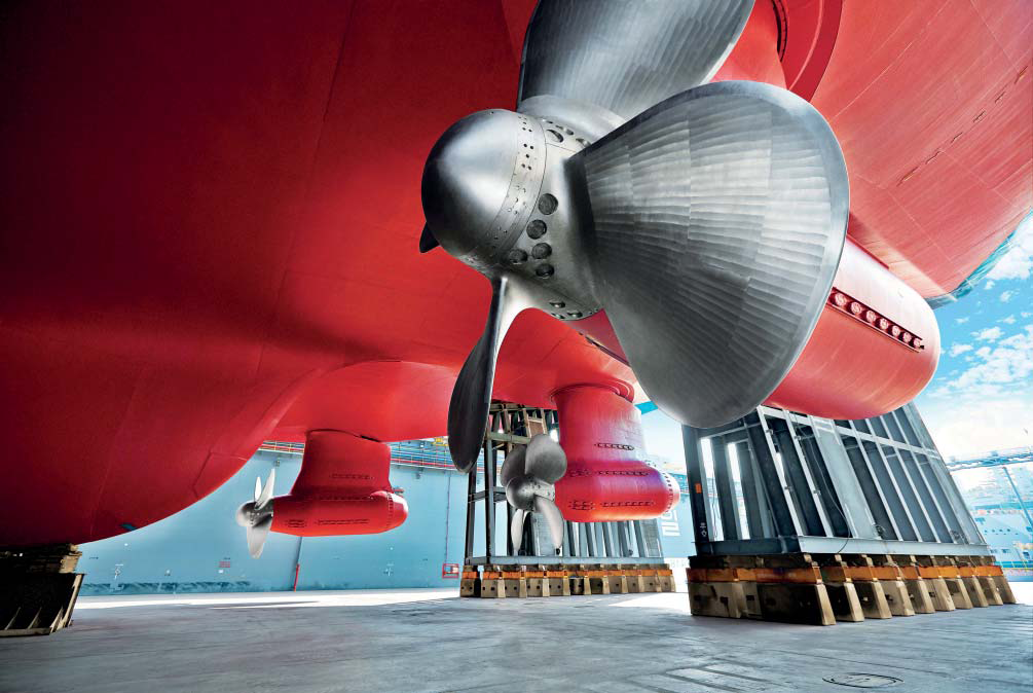
An ABB installation aboard double-acting ferry P&O Pioneer, and its upcoming sister vessel PO Liberte, point the way for how this will come about. Making its way from Guangzhou Shipyard, China (passing Greece at time of writing), the vessel is fitted with four ABB Azipod thrusters. These are powered in part by an 8.8MW/H battery pack supplied by XALT Energy.
Although the ferry is ultimately fossil-fuelled, using four Wärtsilä diesel engines, the addition of a battery performing load-levelling duties allows the vessel to boast a 40% reduction in fuel consumption compared with a conventional diesel-electric vessel, and “.the most sustainable ferries ever to sail on the English Channel,” on P&O’s social media.
Meanwhile the ABB Azipods add to the vessel’s operational flexibility, enabling it to turn on the spot and approach the dock from any direction.
Electrified propulsion is almost completely efficient, and it is inevitable that vessel electrification will grow as more effort is made to curtail emissions. Podded propulsion therefore, still relatively recent, will likely experience a similar trajectory of improvements and optimisations as the more mature technologies such as four-stroke engines.
Wärtsilä is taking a digital approach, through its OPTI-DP programme. Using advanced computational fluid dynamics (CFD), Wärtsilä made the determination that tilting its thruster’s driveshaft and propeller downward
comflot’s Arc7 ice class LNG carrier Christophe de Margerie
by 8 degrees nearly eliminates the problem of the ship’s hull geometry interfering with the thruster’s aft-flow, bringing its ’thrust deduction factor’ down from 014 to 0.02.
This has informed Wärtsilä’s thruster design since. “There is minimal friction with the hull and power losses from the thruster,’ said Wärtsilä product performance manager for thrusters Petra Stoltenkamp, at a conference in January.”The optimal tilt was s·with the flow from the thruster not hindered by the vessel hull or other thrusters. We have shown that less power is needed, by optimising propulsion, reducing design costs and lead times.”
There may be many more exciting changes on the way.
With electrification of ship propulsion on the rise, podded propulsion, tunnel and bow thrusters, will fit into this new paradigm in a way that the conventional combination of prime mover, driveshaft, propeller and rudder will not. For their manufacturers, there has probably never been a more exciting time to be in the business.
A permanent change
A recent trend in the design of thrusters has been concerned with reducing their footprint. Typically, a good way of narrowing the profile of a thruster underwater is relocating its motor and hydraulic systems inboard of the vessel, and connecting to its propellers using a driveline. This has had various benefits; it makes the thruster’s systems easier to inspect and repair by the crew. It has also led to marked improvements in thruster hydrodynamics.
Modern thrusters tend to be sleeker and thinner, with fewer bulbous shapes beneath the waterline, and a better swept area for the propeller, allowing smaller propellers to provide the same propulsive power as a larger thruster with a motor situated inside the hub. Locating the motor inside the vessel’s hull also has the benefit of putting a noise barrier between it and the ocean, meaning less noise is emitted underwater – known as ‘underwater radiated noise’ (URN)
However, there are compromises. For one, increasing the inboard footprint of a thrusters means there is less space. It also increases the noise inside the vessel, and for various new vessel types including SOVs, which have large accommodation blocks for turbine engineers, this is unhelpful.
But recently, thruster manufacturers have been able to improve on these principles further, with the application of permanent magnet technologies. This has changed the design of the thruster once again. Kongsberg’s AZ-PM azimuthing propulsors seem at first glance to be fitted with Mewis Ducts, but in fact, they are ‘rim drive’ thrusters, with a stator inside the rim which manipulates a circular magnetic field A set of permanent magnets inside the rotor causes the propeller to spin.
There are many advantages for this configuration. The thruster is the motor, requiring no motor inside the hull, saving space and reducing noise internally, and having no need for a driveshaft improves the propeller’s efficiency by 10%. This is compounded by the lack of a need for inboard hydraulics and cooling systems.
Another aspect is that by implementing rim drive thrusters, Kongsberg has stumbled upon another benefit – designed this way, the rotors have no tips. This prevents the vortices normally created at the tip of propeller blades, known as cavitation, better optimising the propeller inflow, and eliminating a major source of URN.
Kongsberg is not the only company to have developed a rim-drive thruster; Norway’s Brunvoll and Germany’s Schottel both have their own versions. But the Kongsberg design differs somewhat, featuring a prominent central hub, where the others have none.
Asked whether the hub added hydrodynamic resistance, Kongsberg Technical Product Manager Permanent Magnet Thrusters, Agatha Kalvatn explained that it was “the opposite” – the hub further improves hydrodynamics by preventing cavitation in the centre of the thruster.
In fact, this principle has only just been discovered by the MIT Lincoln Laboratory, in drones, which have recently been fitted with ’toroidal’ figure-8 propellers with no tips. This redesign has reduced the noise output of drone propellers dramatically.
“Most of the noise in a thruster comes from the blade tip cavitation, there are no blade tips in this design,” explained Kalvatn, discussing her company’s range of permanent magnet thrusters. “This thruster was able to get a Silent E notation, because there are no gearings, and we have optimised hydrodynamics with no cavitation.”
Kongsberg has also optimised the geometry of propellers in its TT-PM tunnel thrusters, leading to a simplified design. Conventionally, Kongsberg tunnel thrusters were driveshaft driven with inboard motors, leading to an asymmetrical layout which provided slightly more thrust in one direction than another. But with a rim drive thruster necessitating no driveshaft, Kongsberg has been able to optimise the propeller blades on its tunnel thrusters, to provide equal thrust in both directions.
The PM thrusters’ growing reference list includes Hurtigruten polar cruise vessels Roald Amundsen and Fridjof Nansen, which each feature two TT-PM thrusters of 2m diameter, which each develop 243kN of thrust The Havila Kystruten coastal cruiseferry quartet Capella, Castor, Polaris and Pollux are also so equipped, as well asAllseas Oceanic, a subsea vessel.
“By the end of 2024 we will have 6o units installed,” Kalvatn said “There are rare Earth metals used, as with any permanent magnet design – future designs will consider how to reduce these in construction.”
Kongsberg has shown that it still wants to compete in the non- rim-drive segments however, with a new retractable thruster design, the ULE-PM, in January, featuring a prominent driveshaft and central hub.
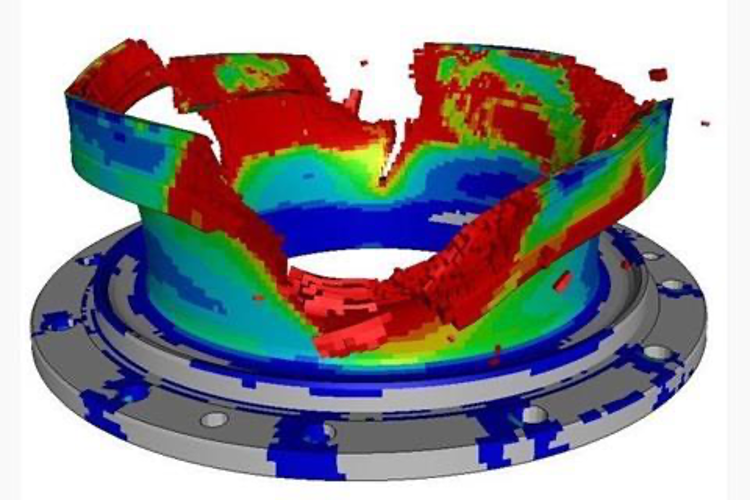
Kongsberg’s permanent magnet rim-drive thruster